Advanced dry AMD
Assistive technology for geographic atrophy
Geographic atrophy (GA) is an advanced form of dry age-related macular degeneration (AMD). Areas of the macula thin over time, causing central vision loss that people often describe as distinct patches rather than a general blur. Every person’s experience is different.
A stage of dry AMD, not a separate disease
Geographic atrophy is the advanced stage of dry age-related macular degeneration rather than a condition apart from it. That matters practically: information written about AMD generally applies, while the everyday experience of GA is often described differently, because the difficulty tends to have edges. Monitoring and treatment decisions belong with an eye doctor.
What people often find difficult
Because the affected areas have shape and position, the same person can find one task easy and another almost impossible depending on where a patch falls. Two people with the same diagnosis can describe very different experiences.
Patches rather than blur
People often describe distinct blank or dim areas in the central view rather than an evenly blurred picture.
Missing parts of words
Reading can break down when a patch falls across the middle of a word or line, even when the print itself is large enough.
Faces and recognition
A central patch can sit exactly where a face would be, making people harder to recognize at conversational distance.
Reduced contrast
Edges and similar tones can be harder to separate, which affects steps, curbs, text on a busy background and food on a plate.
Low light and glare
Dim rooms, uneven lighting and bright glare can each make the same task noticeably harder.
Slower adjustment
Moving between bright and dim places can take longer to settle than it used to.
Strategies and categories of technology
With central patches, training in how to look can matter as much as the device itself. An eye-care or low-vision professional can help someone explore the full range, and more than one kind of support is often used together.
Eccentric viewing
Looking slightly to one side of a target so a more usable part of the retina does the work. Low-vision professionals teach this directly.
Vision rehabilitation
Practical training in how to use remaining vision for specific tasks, at home and outside it.
Optical aids
Magnifiers and filters that enlarge the view or change how it is presented.
Electronic magnification
Electronic magnifiers that enlarge an image and can invert or adjust color and contrast.
Audio assistance
Screen readers and text-to-speech technology that present text as speech instead of as an image.
Live-image processing glasses
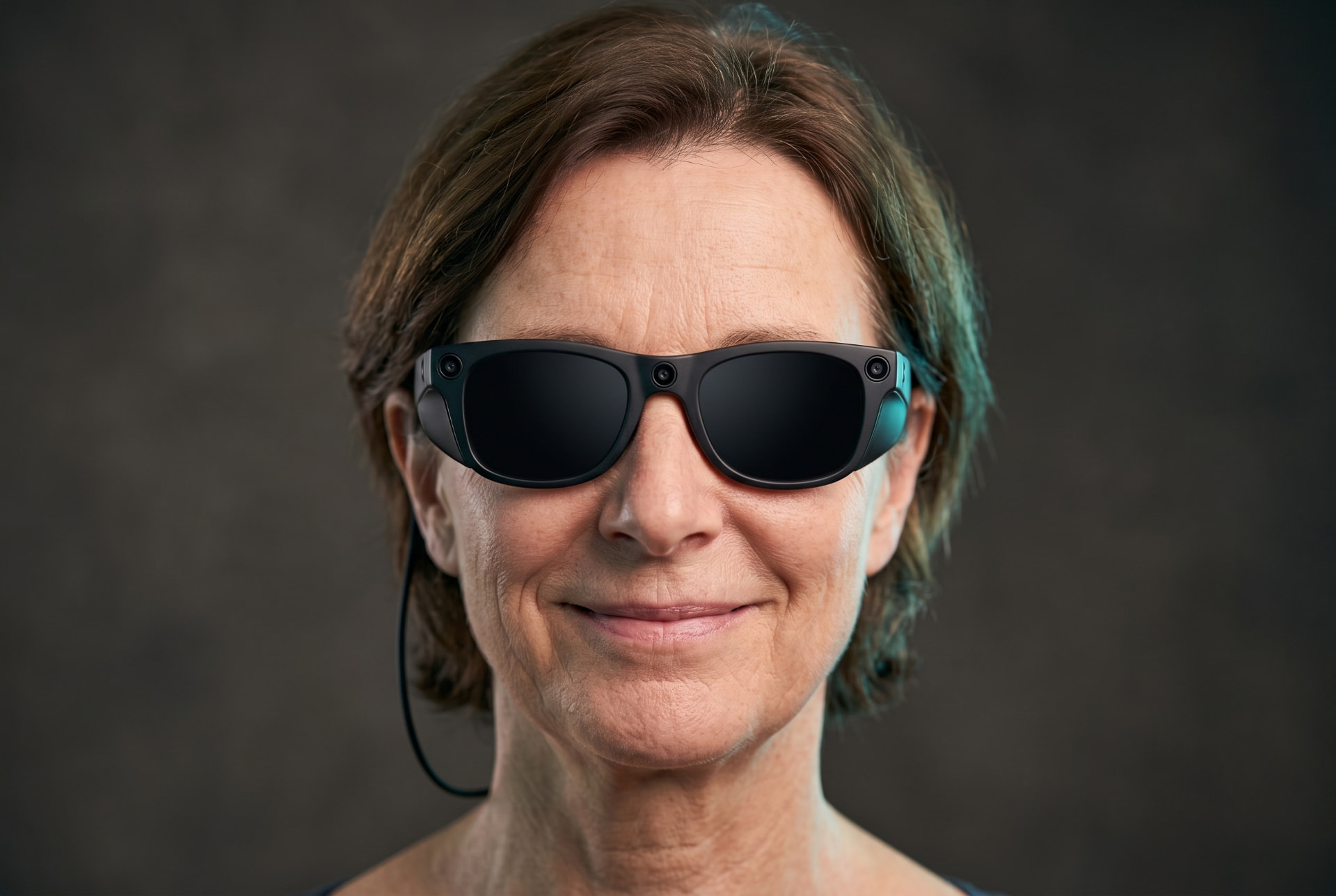
Smart-glasses systems that process a live view and present it through displays near the eyes.
Everyday tasks people want help seeing
Starting from the task rather than the device makes it easier to tell whether something is actually helping.
- Seeing faces and expressions
- Reading print and labels
- Using a computer, phone or kiosk
- Watching television
- Seeing detail in different lighting
- Following a recipe or a form
Questions worth asking about any device
- What kind of visual or audio help does it actually provide?
- Which everyday tasks does the person most want to explore?
- How comfortable is it, and does it fit the person?
- Can it be operated hands-free or by voice?
- Does it need an internet connection?
- Does it work with a prescription?
- What training and ongoing support come with it?
- What is the total cost?
- Can it be tried hands-on before deciding?
Where fits
is a patent-pending vision-assistive smart-glasses system that processes a live view in real time. Six viewing modes give different starting points for daylight, low light, reading, computers and kiosks, edges and television, and Bella voice operation is included at no extra charge for supported functions. Because it presents a processed live view, it is something a person with usable remaining vision can explore directly. Results vary.
What is
is vision-assistive technology. It is not a medical device or a treatment. It does not diagnose, treat, cure, correct or reverse geographic atrophy, and it does not replace an eye doctor or professional medical care. A diagnosis does not establish whether will be useful for a particular person. People with usable remaining vision can explore their own individual response through a hands-on fit check.
is not a mobility, navigation or safety device. Do not rely on it for driving, for walking in traffic, or for any activity where an altered view could create danger.
The honest way to know is to try
A diagnosis of geographic atrophy does not establish whether will be useful for a particular person. During an individual hands-on fit check, someone with usable remaining vision can explore different viewing options and settings using their own eyes and the tasks that matter to them. Results vary from person to person.
Contact us about a fit checkTrusted health-information sources
For general medical information about age-related macular degeneration, including its advanced dry stage:
This page provides general educational information and does not provide medical advice. is vision-assistive technology, not a medical device or treatment, and does not replace care from an eye-care professional.